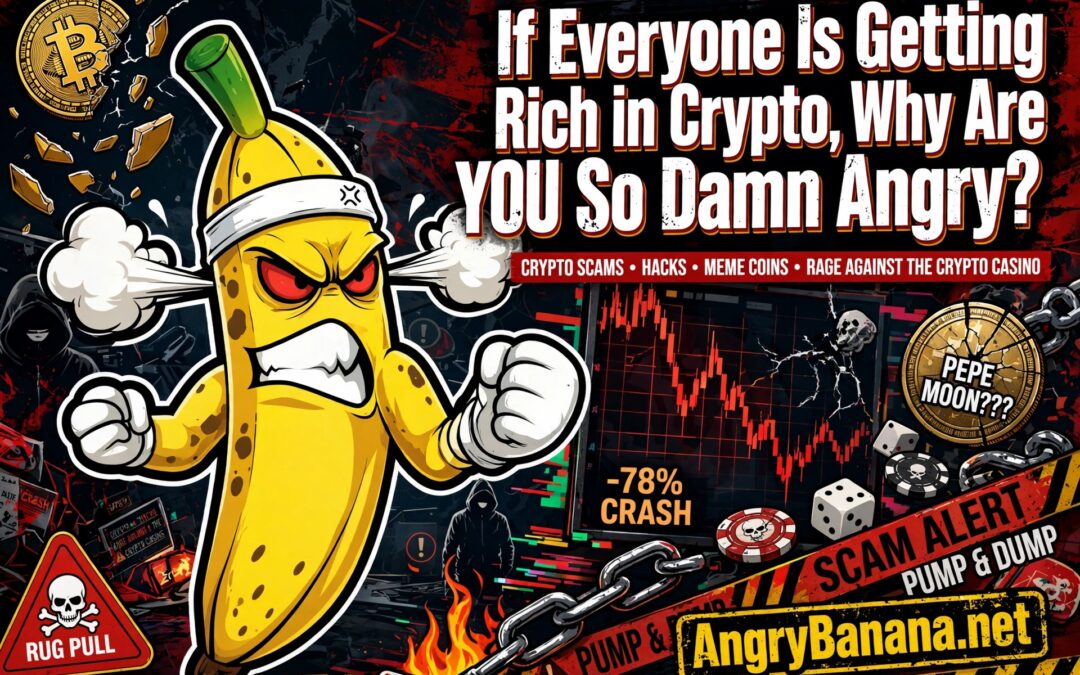
For AngryBanana.net — Reporting current through November 1, 2026
Open your feed. Some guy turned $500 into $500,000.
Some teenager bought a meme coin at 2am and woke up rich. Some trader posts a screenshot of a perfect entry — again. Some influencer with rented-Lambo energy announces “one more opportunity.”
Then you scroll to the replies.
“I got hacked.” “Rugged.” “Liquidated.” “They stopped answering in Discord.” “I’m down 80% and the founder just launched a new coin.”
So which is it? Is crypto the greatest wealth machine in history — or the world’s most efficient anger generator?
Here’s the ugly truth nobody selling you a course wants to say out loud: the winners you see are not a representative sample. They’re the advertisement. You’re the product.
Some people did get rich. Good for them. But a huge chunk of this industry runs on fees, hype, privileged access, and straight-up deception — and it all gets sold to you under the same shiny lie: financial freedom.
Let’s get angry about the right things.
The $6.3 Billion Punch in the Face
You want to know why trust is dead? Look at last week.
On October 30, Binance — Binance, the “too big to fail” exchange — disclosed roughly $6.3 billion in stolen token assets after unauthorized hot-wallet withdrawals. They said they’d cover customer losses from company funds and their SAFU fund. They said about $3 billion was frozen on-chain. Investigation ongoing.
By November 1, Reuters reported Binance claimed it had covered 95% of the stolen tokens and would resume withdrawals in phases. Reuters also reported the FBI attributed the attack to North Korea’s TraderTraitor unit.
Read that carefully: covered is not recovered. Binance replacing your stolen money from its own pocket is not the same as catching the thieves. It’s a bailout with better PR.
And this wasn’t the first. In February 2025, Bybit lost roughly $1.5 billion — also attributed by the FBI to North Korea.
Let that sink in. The blockchain worked perfectly. Blocks kept getting produced. The ledger didn’t lie. And $6.3 billion still vanished because the humans, the wallets, the signing workflows, the systems around the chain failed catastrophically.
“Blockchain security” and “your money is safe” are not the same thing. They never were. Anyone who told you otherwise was selling something.
And here’s the part that should make your blood boil: Binance can afford to eat a $6.3 billion loss. Can you? Can the small exchange you use? Can your buddy who keeps his life savings in a hot wallet because “self-custody is freedom”?
Didn’t think so.
The Numbers They Hope You Never Read
Crypto Twitter runs on screenshots. Reality runs on data. Let’s look at the data:
FBI IC3, 2025: 181,565 crypto-related complaints. $11.366 billion in reported losses. That’s not “paper hands” or “buy the dip.” That’s reported crime — and it’s only the people who bothered to file a report.
Chainalysis, 2025: At least $14 billion in scam activity identified on-chain, projected to top $17 billion once more addresses are tagged. Not market losses. Scams.
BIS research (2015–2022 data): An estimated 73% to 81% of retail Bitcoin investors likely lost money on their initial investment. Read it again. Three out of four.
Pump.fun, January 2025 (via Decrypt): About 0.4% of tracked wallets had realized profits over $10,000. Zero-point-four percent. The other 99.6% weren’t all losers — but the casino sure as hell wasn’t built for them.
Bitquery, October 2026: Of $752.5 million in tracked gains across 3,170 wallets with $100K+ wins, only 26% was classified as ordinary trading profit. 51% involved tokens handed to wallets. 13% was wash loops — trading with yourself to fake volume. Another ~10% couldn’t even be explained.
Translation: half the “genius traders” you admire didn’t trade brilliantly. They got tokens for free, or faked the action.
And before you cite some influencer’s P&L screenshot — CoinGecko’s own Pump.fun analysis admits it excludes unsold worthless positions, nets unrelated tokens together at the wallet level, and doesn’t filter bot and wash-trading activity. A screenshot proves a number appeared on a screen. It proves nothing about what that person actually made or lost overall.
One person can run hundreds of wallets. A wallet can receive tokens it never bought. A trader can post the one green trade and hide the nine red ones bleeding out in another wallet.
You’re comparing your full, painful reality to someone else’s highlight reel. Stop it.
So Who IS Getting Rich? Follow the Money, Dummy
It’s not one villain. It’s a food chain. And you’re near the bottom. Here’s how the people above you eat:
Early insiders and patient holders — They bought before you ever heard the name. Ask: did they actually cash out, or are they just rich on paper? And what risk did they take that you’re not seeing?
Exchanges and launch platforms — They make money every time you click buy or sell. Win or lose, they win. Does your exchange make more when you trade more? Then guess what it wants you to do.
Pro traders and market makers — Spreads, arbitrage, faster bots, better data, co-located servers. You’re bringing a butter knife to a drone strike. Are you really competing — or are you the liquidity?
Founders and early recipients — Allocations at fractions of a cent, “advisor” tokens, team wallets, fee skims. What did they pay? When can they dump? If you don’t know, you’re the exit plan.
Influencers and promoters — Sponsorships, referral kickbacks, paid “alpha groups,” token payments they never disclose. Is that a genuine recommendation — or an ad you weren’t told was an ad?
Criminals — Hacks, rugs, pig-butchering, fake support, drainers. The lowest of the low, and they’re working overtime.
Let’s be clear: running an honest exchange or holding Bitcoin for eight years is not the same as running a pig-butchering scam. Not morally, not legally, not at all.
But incentives don’t care about your morals. A platform can post record revenue while its users get wrecked. An influencer can pocket referral fees from followers who lose everything. A founder’s $0.0001 allocation stays profitable long after you’re down 90%.
So before you ask “how high can this go?” — ask the angrier, better question: who gets paid when I believe this story?
Meme Coins: A Casino Where the House Wears a Funny Hat
Meme coins are funny. They’re cultural. They can be a blast.
None of that makes the launch fair.
By the time you — the public buyer — show up, early wallets have stacked supply, promoters have been paid in tokens, and bots are already positioned to scalp your market buy. You’re not early. You’re the liquidity event.
“A thousand holders!” Sure. One guy can own 300 wallets. “Huge volume!” Wash trading can fake that in an afternoon.
Chainalysis flagged 74,037 tokens launched in 2024 with patterns consistent with pump-and-dumps — 3.59% of launches in its dataset. Those are behavioral flags, not convictions. But it tells you the scale of the rot.
And remember Bitquery: 51% of those big “wins” involved tokens handed to wallets, 13% wash loops. That’s not trading genius. That’s getting the answers before the test.
A coin can also die without a crime. Founders can be incompetent instead of evil. But deliberate deception — hidden allocations, fake volume, paid shills pretending to be believers, devs draining liquidity at 3am — deserves more than the industry’s tired shrug of “that’s crypto, bro.”
No. That’s fraud, bro. Call it what it is.
Your “Community” Was a Marketing Funnel With Emojis
Here’s a painful one. The token still trades. The chart still moves. Three guys still post “GM” every morning.
But the devs are gone. The mods stopped answering. The big promoters are suddenly shilling a different coin.
What happened to the “family”? The “movement”?
It was never a community. It was a temporary agreement to support the price — and the agreement expired.
Everyone wanted something different:
- Early buyers wanted an exit.
- New buyers wanted it to keep pumping.
- Promoters wanted attention and paychecks.
- Founders wanted revenue, funding, or a graceful rug.
- You wanted belonging.
Those interests can overlap for a while. They are not the same thing.
And the second you asked about the treasury, or founder selling, or why the roadmap died — you were “FUD.” You were “disloyal.” Selling was “betrayal.” Asking questions was “negativity.”
Real communities can survive hard questions. Cults can’t.
Ask yourself the one question that kills 90% of crypto “communities” stone dead: if this token went sideways for a full year, what would anyone still come here to do? Build? Play? Learn? Laugh? Make something?
If the answer is “nothing, we’d all leave” — it was never a community. It was a waiting room for the dump.
AI Trading: Now the Bots Are Eating You Too
“AI trading” is the new magic spell. But strip the marketing and it’s a few different things: some systems analyze data, some execute strategies, some are just old bots with a fresh coat of AI paint.
Automated predation isn’t new. Ethereum’s own docs describe sandwich attacks — bots that see your trade coming, jump in front of it, and sell it back to you at a worse price. No chatbot required. Just speed and cruelty.
But AI makes the cruelty scalable:
- Scanning news, socials, and wallets 24/7 for victims… er, “opportunities”
- Generating endless promotional content and fake personas
- Running hundreds of accounts that manufacture “organic excitement”
- Helping scammers research and target you personally
Chainalysis found scam operations linked to AI vendors pulled in roughly 4.5x the revenue per operation of those without. Correlation, not proof of causation — but do you really want to bet your savings that it’s a coincidence?
Picture it: one set of machines manufactures hype. Another set of machines trades the reaction. And you — a human with a phone and feelings — see a “wave of enthusiasm” and think it’s real people agreeing.
It might be 40 bots and three guys.
Buying an “AI trading bot” won’t save you. Bots lose money too. They follow bad signals, amplify errors, and get outplayed by better bots. The loser isn’t always the human — sometimes it’s the worse machine.
The only question that matters: do you actually have an edge, or are you just reacting to someone else’s signal? If you can’t answer that clearly, you’re the edge — for someone else.
Why You’re Not Just Broke — You’re Betrayed
Losing money hurts. Being played makes you furious. And that’s the real story here.
It’s not just the losses. It’s this:
The comparison never stops. You see your losses in full, ugly detail. You see everyone else’s wins, cropped and filtered.
The game feels rigged. Because sometimes it is. Different entry prices, hidden allocations, paid promoters, insider wallets — you found out after you bought.
The “freedom” feels like a second job. Seed phrases, approvals, revoking permissions, checking contracts, tracking taxes, watching charts at 2am. This was supposed to liberate you?
Responsibility gets shoved downhill. “Do your own research” is great advice — until it’s used as a shield by people who knew you couldn’t possibly detect the scam. DYOR doesn’t work when the game is “spot the invisible crime.”
Hope makes you vulnerable. When the normal paths — wages, housing, savings — feel locked, a 100x starts feeling necessary, not optional. And the people selling shortcuts know exactly how desperate you are.
Your anger isn’t irrational. It’s information. Listen to it.
What To Do: The Angry Banana Rage-Proof Playbook
Anger without action is just stress. Here’s how to turn the rage into armor. No fluff. Do these:
- Assume every “opportunity” is guilty until proven innocent.
Who gets paid if you buy? Founders? Influencers? The exchange? If you can’t answer in 30 seconds, walk away. Legit projects can explain their money flow. Scams get offended when you ask. - Never, ever share your seed phrase. Ever.
No support agent needs it. No “validator” needs it. No airdrop needs it. Anyone who asks is a thief. Full stop. Write it on paper, store it offline, and treat anyone who asks for it like they’d just tried your door handle at midnight. - Separate your money like it matters — because it does.
Long-term holdings live in a hardware wallet that never touches sketchy sites. Your “degen” experiments live in a separate hot wallet with money you can light on fire without crying. Never mix them. - Treat every unsolicited message as an attack.
“Support” DMing you first? Attack. “Exchange” telling you to move funds to a “safe wallet”? Attack. Stranger offering to recover your stolen crypto for an upfront fee? That’s a recovery scam — thieves robbing you twice. Real support waits for you to come to them through official channels you verified yourself. - Reject guaranteed returns on sight.
Guaranteed 2% daily? Guaranteed 10x? It’s a lie. Screenshots prove nothing. Testimonials are bought. Audits help but guarantee nothing — auditors get fooled and bought too. If the yield makes no economic sense, you’re the yield. - Before you buy any token, interrogate it like it owes you money.
Who controls the supply? Can they mint more? Can they freeze your tokens? Can they change the tax to 99%? How much real liquidity exists — not market cap, but actual dollars you could exit into? Market cap is a fantasy number. Liquidity is the truth. - Read the approval before you sign it.
Your wallet popping up “approve spending of unlimited tokens” is handing a stranger your debit card. Use revocation tools regularly. If a site asks for unlimited approval and won’t work without it, that’s your answer about the site. - Verify, then trust, then verify again.
Airdrop link? Go to the project’s official site by typing it yourself and check the announcement there. Never click the link in the DM, the reply-guy comment, or the “urgent” email. Bookmark the real sites. Paranoia is a feature now. - If it’s a community, test it.
Ask a hard, fair question in public: treasury spending, founder sales, missed roadmap items. A real community debates it. A cult bans you. Getting banned for a reasonable question just saved you money — say thanks and leave. - If you’ve been scammed: stop the bleeding, then report.
Stop sending money immediately — the “pay a release fee to unlock your withdrawal” is always fake. Screenshot everything: messages, addresses, transaction hashes. Contact the exchange through verified channels. File with the FBI’s IC3 and the FTC. Crypto payments are brutally hard to reverse, but fast reporting has frozen funds before. Silence guarantees the scammer wins twice.
The Bottom Line
Crypto isn’t dead. But the fairy tale is.
Financial freedom was supposed to mean less dependence on rigged systems — not 24/7 chart surveillance, not trusting anonymous founders with your rent money, not getting front-run by bots while an influencer dumps on you.
The technology can still be useful. But usefulness has to be proven — in outcomes you can understand — not promised in a whitepaper written by someone holding 20% of the supply.
So stay angry. But stay angry at the right targets: the hidden allocations, the fake volume, the undisclosed paychecks, the “communities” that ban questions, the exchanges that call a bailout a recovery.
And the next time someone asks you “which coin will make me rich?” — hit them with the only question that matters:
Who gets paid when I believe this story — and what proof do I have that I’m not just the exit liquidity?
Stay angry. Stay sharp. Don’t be the liquidity.
— Angry Banana 🍌💢 Where Rage Meets Redemption.