
If This Doesn’t Make You Angry, You’re Not Paying Attention – Corruption in Plain Sight: Why Are So Many People Looking Away?
Why Aren’t You Angry?
Seriously. What is wrong with us?
How can we watch scandal after scandal, conflict after conflict, investigation after investigation, and just shrug?
How can we see powerful people accused of lying, enriching themselves, rewarding friends, attacking critics, and bending rules that would crush ordinary citizens—and somehow treat it like just another Tuesday?
Have we become numb?
Have we been flooded with so much outrage that we’ve lost the ability to recognize when something is genuinely outrageous?
Why aren’t more people furious? Not furious because of party politics.
Not furious because of Democrats versus Republicans. Furious because accountability seems to disappear the higher someone climbs.
Furious because the rules often appear different for the rich, the powerful, the connected, and the famous.
Furious because every new controversy gets swallowed by the next news cycle before anyone has time to demand answers.
Maybe you agree. Maybe you don’t. But here’s the challenge:
If a politician you disliked was accused of the exact same behavior, would you be defending it?
If a CEO did it, would you call it corruption? If your neighbor did it, would you call it fraud?
If the answer changes depending on who is involved, then maybe the problem isn’t the scandal.
Maybe the problem is us. Maybe we’ve become fans instead of citizens. Maybe we’ve become spectators instead of watchdogs.
Maybe we’ve stopped expecting integrity from the people who wield enormous power over our lives.
Angry Banana isn’t here to tell you what to think. We’re here to ask why so many people have stopped asking questions.
We’re here to challenge narratives. We’re here to shine a spotlight on hypocrisy, corruption, self-dealing, and abuses of power—wherever they exist.
Because democracy only works when people care. And if you’re not at least a little angry, you might not be paying attention.
Welcome to Angry Banana. – The fruit is angry so you don’t have to be.
Power deserves scrutiny. Influence deserves accountability. No politician should be above criticism.
VISIT: https://joinftc.co/
Key Takeaways: Trump Corruption Allegations at a Glance
- Trump’s legal and ethical controversies span business, politics, elections, government oversight, and personal conduct, making him one of the most investigated public figures in modern American history.
- The Trump Organization faced major fraud allegations over asset valuations, resulting in significant court rulings and financial penalties, although portions of the case remain subject to appeals and legal challenges.
- Critics argue Trump blurred the line between public office and private business, citing his continued ownership of hotels, golf resorts, media ventures, and cryptocurrency projects while serving as president.
- Election-related investigations focused on efforts to challenge the 2020 election results, including the Georgia election case, alternate elector strategies, and actions surrounding January 6, 2021.
- Trump became the first U.S. president to be impeached twice, with the first impeachment involving Ukraine and the second centered on the events leading up to the Capitol riot.
- Ethics watchdogs have documented thousands of alleged conflicts of interest, involving donors, lobbyists, foreign governments, family businesses, and Trump-owned properties.
- Questions about foreign influence and self-dealing emerged repeatedly, particularly regarding spending by foreign officials at Trump properties and the role of family members in government and business activities.
- Recent controversies include Trump-linked cryptocurrency ventures and the proposed Anti-Weaponization Fund, both of which have generated new debates over transparency, accountability, and conflicts of interest.
- Supporters maintain that many investigations were politically motivated, pointing out that some cases were dismissed, reduced on appeal, or never resulted in criminal convictions.
- Critics contend that Trump’s actions represent a pattern of using public power for private benefit, while supporters view the investigations as evidence of unprecedented political targeting.
- The broader debate is not just about Donald Trump, but about presidential ethics, accountability, conflicts of interest, and the strength of democratic institutions in the United States.
- Whether viewed as corruption or political persecution, Trump’s controversies have fundamentally reshaped discussions about power, transparency, and governance in America.
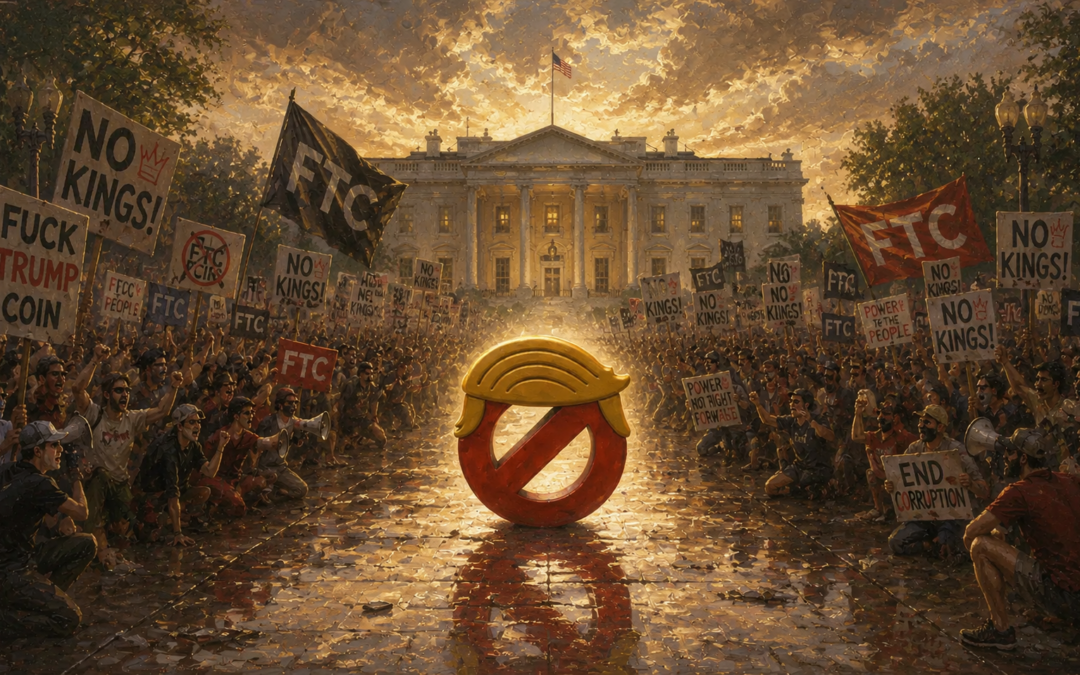
F**k Trump Coin ($FTC): A Digital Protest Movement
F**k Trump Coin ($FTC) wasn’t born yesterday.
The project first emerged in 2018 on Ethereum with a simple idea: create a decentralized symbol of resistance against what many viewed as the growing influence of Donald Trump. At the time, only a handful of people paid attention. A few dozen supporters became a few thousand, but the broader market wasn’t ready. Like many ideas that arrive before their moment, the movement eventually faded into the background.
Today, that moment has returned. FTC is more than a cryptocurrency. It is a digital protest. A statement. A community-driven movement built around the belief that ordinary people are stronger when they stand together than when they stand alone.
There are no gatekeepers here. No institutions controlling the message. No corporate boardrooms deciding what can or cannot be said. FTC exists because a community chooses to participate and amplify a shared voice.
What FTC Represents
Let’s be clear about what FTC represents. This is not a protest against conservatives. It is not a protest against Republicans. It is not a protest against MAGA supporters.
It is a protest against Donald J. Trump.
To many supporters of FTC, Trump has become a symbol of concentrated power, influence, and self-interest operating without sufficient accountability. They view him as a political figure who has repeatedly leveraged attention, controversy, and influence to expand his own brand, businesses, and wealth while holding the highest office in the world.
For the FTC community, the issue extends beyond one politician. It is about challenging corruption, conflicts of interest, unchecked influence, and the growing belief that powerful individuals often play by a different set of rules than everyone else.
Why Crypto?
The concerns extend into the cryptocurrency world itself.
Many FTC supporters believe crypto was created to challenge centralized power and give ordinary people greater control over their financial future. They argue that political influence, insider advantages, and celebrity-driven financial schemes undermine those principles.
FTC exists as a decentralized expression of frustration, accountability, and resistance.
Join the Movement
FTC is for people who are tired of corruption. Tired of double standards. Tired of watching the powerful get richer while accountability becomes increasingly rare.
Whether you see FTC as a protest, a meme, a movement, or simply a statement, its message is straightforward:
Power deserves scrutiny.
Influence deserves accountability.
No politician should be above criticism.
If that resonates with you, join the movement.
🌐 Website: https://joinftc.co/
🚀 Sign Up & Earn FTC:
https://joinftc.co/
Invite Friends, Build the Community, and Help Amplify the Message. When enough people speak together, their voice becomes impossible to ignore.
#FTC #FuckTrumpCoin #CryptoProtest #PoliticalCrypto #BlockchainActivism #Decentralization #CryptoCommunity #Web3 #FreedomOfSpeech #Accountability
Trump Corruption Allegations: An Extended Overview of the Major Scandals, Investigations, and Ethics Controversies
Donald Trump’s business, political, and legal history has been surrounded by a long list of corruption allegations, ethics disputes, civil lawsuits, criminal investigations, impeachment proceedings, and watchdog complaints. Some matters resulted in court findings, civil liability, impeachment, or formal investigations. Others remain allegations that Trump and his supporters strongly deny.
1. Business & Financial Conduct
Trump Organization Civil Fraud Case
One of the most significant business-related cases involved the Trump Organization’s financial statements. New York Attorney General Letitia James accused Trump, his company, and several executives of inflating asset values to obtain favorable loan and insurance terms.
In 2024, Judge Arthur Engoron found Trump and the Trump Organization liable for persistent fraud and imposed a major financial penalty. However, in August 2025, a New York appeals court threw out the roughly half-billion-dollar penalty while leaving parts of the case and legal controversy alive. Trump has continued trying to get the case fully dismissed.
The broader issue was not simply one disputed property value. The case centered on whether Trump’s financial empire used exaggerated valuations as a regular business practice. Critics viewed it as evidence that Trump’s wealth and business success were partly built on manipulation of numbers. Trump and his defenders argued the case was politically motivated and that no banks were harmed.
Conflicts of Interest During Presidency
Trump broke with modern presidential tradition by refusing to fully divest from his business empire while serving as president. Instead, he placed control of his companies in the hands of family members while retaining ownership interests.
Critics argued this created a constant conflict between public duty and private profit. Trump hotels, golf courses, and resorts became gathering places for lobbyists, Republican groups, foreign officials, political donors, and government-connected interests. Watchdog groups argued that people seeking influence could spend money at Trump properties while Trump was in office, creating the appearance that access and profit were intertwined.
Supporters argued that Trump had a right to keep his business interests and that many presidents entered office with wealth or private connections. Critics countered that Trump’s situation was different because his brand, properties, and family businesses remained highly visible and active while he exercised presidential power.
Cryptocurrency Ventures
Trump-linked crypto ventures added a new layer to the conflict-of-interest debate. During Trump’s second presidency, ethics experts raised concerns that family-linked crypto businesses could benefit from regulatory decisions made by the administration. AP reported that legal and ethics experts saw Trump Media’s crypto-related dealmaking as a case study in second-term conflicts, especially where companies regulated by the federal government also had business relationships with Trump-linked entities.
The core concern is simple: crypto markets are highly sensitive to regulation. If a sitting president or his family is financially connected to crypto ventures, critics argue that policy decisions could directly or indirectly benefit private business interests. Supporters argue that crypto is a legitimate industry and that Trump’s pro-crypto stance reflects policy preference, not corruption.
2. Election-Related Allegations
Georgia Election Interference Investigation
The Georgia election case focused on Trump’s efforts to challenge the 2020 election results in Georgia. The most famous moment was Trump’s phone call asking Georgia Secretary of State Brad Raffensperger to “find” enough votes to alter the state result.
Prosecutors alleged a broader effort involving pressure on state officials, alternate electors, and attempts to undermine the certified election outcome. The case later faced major procedural problems after Fulton County District Attorney Fani Willis was disqualified, and by late 2025, the remaining criminal charges against Trump had been dropped.
Critics still view the Georgia episode as one of the clearest examples of attempted election subversion. Supporters argue Trump genuinely believed the election was flawed and had a right to challenge results through legal and political channels.
January 6 and Election Certification
The January 6 controversy remains one of the central corruption and abuse-of-power allegations against Trump. Federal investigations examined whether Trump’s false claims of a stolen election, pressure campaign against Vice President Mike Pence, and public rally rhetoric contributed to the attack on the U.S. Capitol.
Critics argue that Trump attempted to overturn a lawful election and used the power of his office to pressure institutions into rejecting the certified result. Supporters argue Trump’s speech was protected political expression and that responsibility for violence belongs to those who broke the law.
The dispute goes beyond criminal liability. It raises a deeper question: can a president use public office, political pressure, and mass persuasion to challenge the peaceful transfer of power without crossing into corruption or authoritarian conduct?
Ukraine Pressure Campaign: First Impeachment
Trump’s first impeachment centered on Ukraine. House Democrats accused him of pressuring Ukrainian President Volodymyr Zelensky to announce investigations into Joe Biden and Biden’s son Hunter while U.S. military aid was being withheld.
The House impeached Trump in 2019 for abuse of power and obstruction of Congress. The Senate acquitted him in 2020.
Critics argued this was a classic abuse of office: using foreign policy and taxpayer-funded military aid to pressure another country into helping his political campaign. Supporters argued there was no explicit quid pro quo and that Trump had a legitimate interest in corruption involving Ukraine.
3. Ethics & Self-Dealing Allegations
Use of Trump Properties
A recurring criticism throughout Trump’s presidency was that government and political activity often flowed through Trump-owned properties. Events, fundraisers, official travel, and political gatherings at Trump hotels and resorts created the perception that public service and private revenue were overlapping.
This became especially controversial when Secret Service stays, official delegations, or political groups spent money at Trump properties. Critics argued that even if transactions were technically legal, they created a pay-to-play atmosphere.
Foreign Government Spending
Foreign government spending at Trump properties raised constitutional and ethical concerns, especially under the Emoluments Clause, which restricts federal officials from accepting benefits from foreign states without congressional consent.
Critics argued that foreign officials had an incentive to patronize Trump properties to curry favor. Trump’s defenders argued that routine hotel payments were not corrupt gifts and that lawsuits over emoluments were politically driven.
Family Business Connections
Trump’s children and son-in-law played unusually visible roles in both politics and business. Critics argued that the Trump family blurred the line between government service, political influence, branding, and private enrichment.
This concern extended across real estate, licensing, foreign deals, media, and later crypto ventures. The central allegation was not always that a specific law was broken, but that the presidency itself became intertwined with the family business machine.
4. Justice Department & Oversight Controversies
Inspectors General Dismissals
Inspectors general are internal watchdogs meant to investigate waste, fraud, abuse, and misconduct inside federal agencies. Trump’s removal or replacement of several inspectors general drew criticism from watchdogs and Democrats, who argued that it weakened independent oversight.
Supporters argued presidents have authority to remove executive branch officials and that some watchdogs were biased or ineffective. Critics argued that removing watchdogs during sensitive investigations sends a chilling message to anyone trying to expose wrongdoing.
Public Integrity and DOJ Oversight
Recent reporting has raised concerns about changes to Justice Department units responsible for corruption and public-integrity investigations. Critics argue that weakening these offices reduces accountability for political figures and powerful insiders.
The broader concern is institutional: if the agencies designed to investigate corruption are weakened, politicized, or redirected, public officials may face less scrutiny.
Ethics Enforcement Rollbacks
Watchdog organizations have argued that Trump-era ethics enforcement was weakened through looser standards, reduced transparency, resistance to subpoenas, and attacks on oversight institutions.
Trump’s supporters frame this differently. They argue the federal bureaucracy, watchdog groups, and prosecutors were often hostile to Trump and used ethics claims as political weapons. This dispute is central to Trump’s own “weaponization” narrative.
5. Civil Liability Cases
E. Jean Carroll Cases
Trump was found civilly liable for sexual abuse and defamation involving writer E. Jean Carroll and ordered to pay substantial damages. The cases became major legal and political flashpoints, with Trump denying wrongdoing and continuing to challenge the outcomes.
Although not a corruption case in the traditional financial sense, the Carroll litigation is often included in broader discussions of Trump’s legal exposure, personal conduct, and use of public platforms to attack accusers.
Defamation and Other Civil Litigation
Trump has faced numerous lawsuits connected to business practices, campaign statements, personal conduct, media disputes, and public claims. Some were dismissed, some settled, and some resulted in judgments.
The larger pattern matters to critics because they see repeated litigation as evidence of a long-running disregard for legal and ethical boundaries. Supporters argue that Trump is uniquely targeted because he is politically polarizing and wealthy.
6. Second-Term Ethics Controversies: 2025–2026
“Anti-Weaponization Fund”
One of the biggest second-term controversies is the proposed “Anti-Weaponization Fund,” reportedly tied to a settlement involving Trump’s lawsuit over leaked tax returns. Critics described the fund as a political slush fund that could benefit Trump allies and potentially people connected to January 6. A federal judge temporarily blocked payouts from the roughly $1.776 billion fund while legal challenges continue.
Supporters argue the fund is meant to compensate people harmed by politically motivated prosecutions or government abuse. Critics argue it lacks transparency, bypasses normal congressional spending authority, and could turn taxpayer money into political rewards.
The legal fight is still unfolding, and no final ruling has resolved the controversy.
Conflicts of Interest Trackers
Multiple watchdog organizations continue to track alleged conflicts involving Trump, his family, donors, administration officials, regulatory decisions, and private business interests.
These trackers matter because corruption is not always one dramatic criminal act. Often it is a pattern: donors receiving access, businesses gaining favorable treatment, agencies changing enforcement posture, and private interests benefiting from public power.
7. What Critics and Supporters Disagree On
Critics Argue
Critics believe Trump repeatedly blurred the line between public office and private gain. They argue his business empire, family ventures, political operation, and presidential power became too closely connected.
They also argue that Trump weakened oversight institutions, attacked prosecutors and judges, removed watchdogs, resisted transparency, and normalized conflicts of interest that would have been unacceptable for previous presidents.
To critics, the central theme is not one scandal but a governing style: loyalty over independence, profit over ethics, and personal power over institutional restraint.
Supporters Argue
Trump’s supporters see the same events very differently. They argue many allegations are politically motivated, exaggerated, or selectively enforced. They point out that some investigations did not result in criminal convictions, some cases were dismissed, and some penalties were reduced or overturned on appeal.
Supporters also argue that Trump was targeted by hostile prosecutors, media organizations, bureaucrats, and watchdog groups because he challenged the political establishment.
To supporters, the central theme is not corruption but persecution.
Major Categories Summary
| Category | Examples |
|---|---|
| Business Fraud | Trump Organization valuation case |
| Conflicts of Interest | Hotels, resorts, foreign spending, crypto ventures |
| Election Issues | Georgia case, alternate electors, January 6 |
| Impeachment | Ukraine pressure campaign |
| Civil Liability | E. Jean Carroll cases, defamation rulings |
| Ethics Concerns | Family business ties, donor access, private profit |
| Oversight Issues | Inspector general removals, DOJ restructuring |
| Current Controversies | Anti-Weaponization Fund, crypto conflicts, donor influence |
Conclusion
The corruption allegations surrounding Donald Trump are unusually broad because they span business, politics, elections, courts, family ventures, foreign influence concerns, and government oversight. Some claims resulted in court findings or civil liability. Others remain disputed allegations. Some were dismissed or weakened on appeal. Many continue to be litigated politically, legally, and historically.
The clearest way to understand the Trump corruption debate is this: critics see a long-running pattern of self-dealing, institutional pressure, and ethical boundary-breaking; supporters see a long-running campaign of selective prosecution and political warfare.
Either way, Trump’s record has reshaped the national conversation about presidential ethics, conflicts of interest, accountability, and whether American institutions are strong enough to police corruption at the highest levels of power.